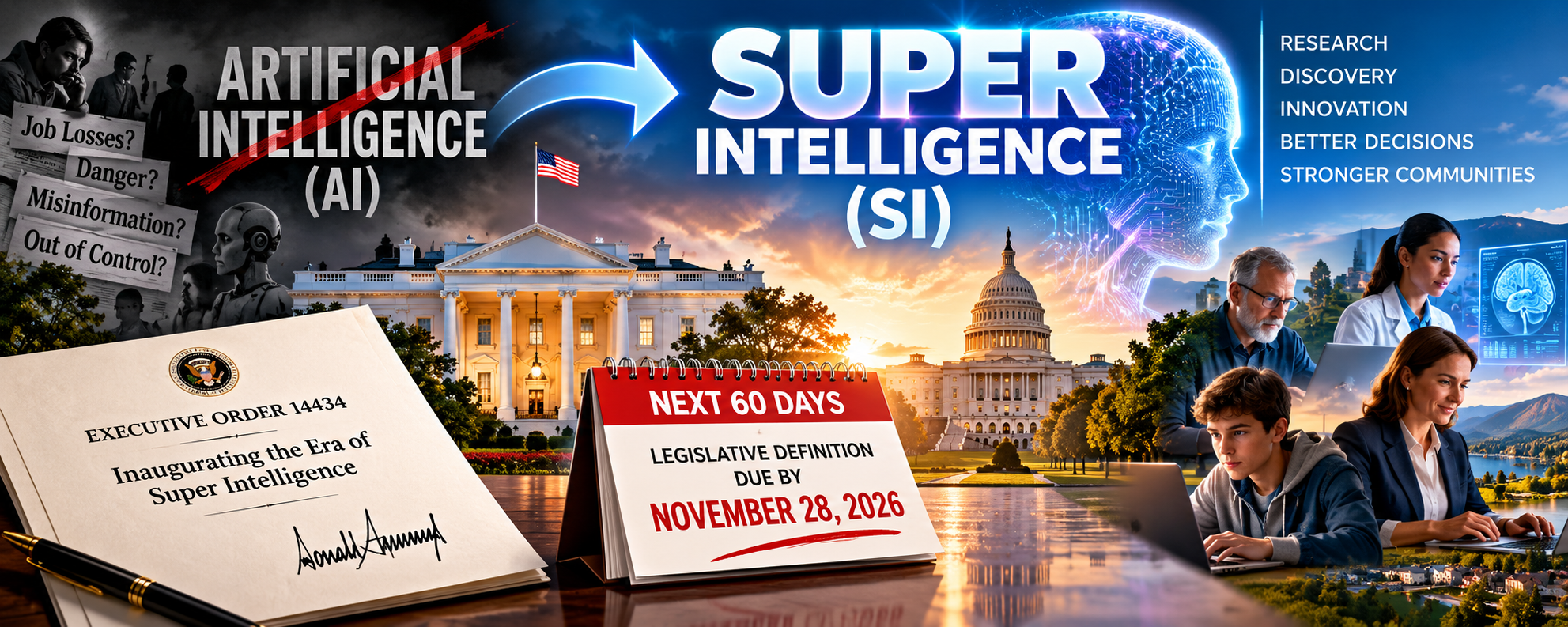
The End of Artificial Intelligence: Washington Has Finally Recognized What Needs to Be Done
October 12, 2026
The United States has officially begun replacing the term Artificial Intelligence with Super Intelligence. A presidential executive order is now in effect, federal agencies are being directed to change their terminology, and a new legislative definition is due before the end of November. But the significance of this development goes well beyond changing two letters.
A Name That Should Have Been Abandoned Years Ago
Some time ago, I wrote an article arguing that we should stop calling one of the most remarkable technological developments in human history Artificial Intelligence. I considered the expression misleading, outdated, and unnecessarily dismissive of a technology that is fundamentally changing how people research, write, calculate, analyze information, and solve problems.
My argument was relatively simple. When somebody uses a calculator to add up their bills, nobody accuses them of practicing artificial mathematics. When an engineer uses sophisticated computer software to design a bridge, nobody dismisses the calculations as artificial engineering. When a physician uses diagnostic technology to examine medical evidence, we do not describe the results as artificial medicine.
Yet somehow, when sophisticated software processes enormous amounts of information, identifies patterns, generates explanations, and assists humans in solving complex problems, we insist on describing the technology as artificial.
I have never considered that a particularly intelligent way of describing intelligence.
The word artificial does have an established technical meaning. It distinguishes human-engineered systems from naturally occurring intelligence, and it does not necessarily imply that the technology is fraudulent or worthless. Nevertheless, words also shape public perception, and I believe the expression has become increasingly inadequate as the technology has developed.
That was why I proposed abandoning the terminology in favor of Strategic Intelligence Software, a description that places the emphasis where I believe it belongs: on the sophisticated application of computational intelligence to human problems.
I published that argument well before the latest announcement from Washington. Subsequently, my article circulated on social media, including Truth Social, and I received indications that it had attracted attention beyond my usual readership.
Now, something quite remarkable has happened.
The United States government has formally adopted a policy to retire the terminology I have been criticizing, although it has chosen a different replacement.
Washington Has Made Its Decision
On September 29, 2026, President Donald Trump signed Executive Order 14434, Inaugurating the Era of Super Intelligence. The order was subsequently published in the Federal Register on October 2, giving the administration’s terminology policy formal expression in a presidential directive.
The order explains that the capabilities of modern intelligence systems have advanced considerably beyond what researchers envisioned when the original terminology emerged approximately 70 years ago. It argues that these systems increasingly amplify human ingenuity, contribute to scientific discovery, and expand what people can accomplish in medicine, research, engineering, and other fields.
The administration has therefore directed federal executive agencies to use the terms Super Intelligence (SI) rather than Artificial Intelligence (AI) in official correspondence, government websites, policy documents, reports, and other non-statutory communications, subject to existing law.
This is not merely a presidential preference expressed during a speech. It is a formal executive direction to federal agencies, accompanied by instructions to develop a legislative framework for the terminology.
The order also recognizes that existing laws cannot simply be rewritten by presidential declaration. Previously issued regulations, contracts, grants, and historical documents do not have to be changed, while statutory amendments remain a matter for Congress.
Nevertheless, the direction is unmistakable. Within the executive branch, the United States government has begun moving away from the traditional terminology.
Source: White House, Executive Order 14434, September 29, 2026.
The Next 60 Days Could Be Particularly Important
What interests me most about this development is not simply the decision to change the terminology. It is the mechanism the administration has established to implement that decision.
Section 3 of the executive order gives the Assistant to the President for Science and Technology 60 days to prepare proposed legislative language establishing a federal definition of Super Intelligence.
That deadline falls on November 28, 2026.
The proposed legislation must consider whether the existing statutory definition of artificial intelligence should be modified, expanded, or superseded. It must also identify existing federal statutes that might require corresponding amendments and recommend additional executive measures necessary to implement the new terminology throughout the federal government.
That creates an important distinction between what has already happened and what may happen next.
The terminology directive is already in effect for covered executive-branch communications. The legislative proposal is still being developed, and any subsequent change to federal statutes would require the appropriate legislative process.
During the coming weeks, we can therefore expect continued administrative implementation, including updates to government documents and websites, while the White House prepares its legislative recommendations.
Whether Congress eventually adopts a new statutory definition, how broadly the administration applies the terminology, and whether other governments follow Washington’s example remain open questions.
But the process is underway, and the next major milestone is clearly established.
The Technology Industry Is Already Responding
The changes are not confined to government departments.
On October 4, Reuters reported that Elon Musk had agreed to rename SpaceX’s intelligence division from SpaceXAI to SpaceXSI. The proposed change followed President Trump’s public endorsement of the new terminology, although Musk did not provide a date for implementing the new name.
Other technology companies have also begun discussing the terminology. Yet the response is far from universal, and there is no requirement for private businesses to abandon the expression Artificial Intelligence. Some industry leaders continue to use AI, while others have embraced SI as a better description of the technology’s direction. The Verge
The federal government’s own website provides an interesting illustration. AI.gov now prominently describes the administration’s Super Intelligence strategy, and its educational initiatives have adopted the SI terminology. However, the website continues to operate under the AI.gov address.
That tells us something about how such transitions occur. Changing a government’s terminology policy is relatively straightforward. Changing the thousands of documents, computer systems, educational programs, organizational practices, and established conventions that depend upon that terminology is another matter.
This transition will not happen overnight, and there is no guarantee that Super Intelligence will become the preferred expression throughout the technology industry.
Nevertheless, it is significant that the United States government has decided to formally challenge terminology that has dominated computer science for approximately seven decades.
What About All the Fear Surrounding Artificial Intelligence?
Here is where I believe this discussion becomes particularly important for ordinary citizens.
Over the past several years, the public has been subjected to an enormous amount of commentary about the supposed dangers of artificial intelligence. We hear predictions about machines taking control of society, eliminating millions of jobs, manipulating elections, replacing human judgment, and eventually developing capabilities beyond our ability to manage.
Some of these concerns deserve serious consideration. Fraudulent impersonations, fabricated evidence, unreliable information, privacy violations, and the displacement of certain forms of employment are legitimate issues that governments and citizens must address.
But there is an enormous difference between identifying a genuine technological risk and treating the underlying technology as something inherently sinister.
We have encountered this distinction many times throughout history.
The introduction of industrial machinery transformed employment. Computers displaced entire categories of clerical work. Electronic databases changed how governments managed information, while the Internet fundamentally altered publishing, commerce, communications, and public access to knowledge.
Each development introduced new risks, eliminated some established practices, and created opportunities that previously did not exist.
Intelligence software is following a similar pattern, although its ability to generate language, images, computer code, and increasingly sophisticated analysis raises challenges that earlier technologies did not.
The appropriate response is not to frighten people into avoiding it. It is to teach them how to use the technology competently, understand its limitations, verify its outputs, and recognize when human expertise remains essential.
A citizen who understands how to use these systems has access to research and analytical capabilities that would have been difficult or expensive to obtain only a few years ago.
That represents an extraordinary opportunity, particularly for people who previously lacked access to specialized professional resources.
Intelligence Software Is a Tool, Not a Substitute for Judgment
I spent much of my professional career in the British Columbia justice system, including years working as a policy analyst and developing computer-based information systems. Long before today’s language models existed, I was writing database applications, working with specialized software, and developing interactive training programs.
I learned something important during those years.
A computer can process information at extraordinary speed, but the quality of the result still depends heavily on the information supplied, the design of the system, and the competence of the person interpreting the output.
That fundamental principle has not disappeared.
Today’s advanced intelligence systems can examine large quantities of information, compare documents, identify inconsistencies, generate alternative explanations, and assist with research. Yet they can also produce confident-sounding errors, misunderstand context, omit relevant evidence, or present unsupported assertions.
Those limitations are reasons for verification, not reasons to abandon the technology.
When I conduct policy or legal research, I do not regard software-generated analysis as a substitute for examining legislation, judicial decisions, official records, or the underlying evidence. I regard it as a means of accelerating the investigative process and expanding the range of information that can be considered.
That is an important distinction for anyone using these technologies in public administration.
A municipal council considering a complicated development proposal could use intelligence software to compare planning documents, identify potential conflicts, summarize public submissions, and examine alternative policy approaches.
A citizen could use the same technology to understand municipal budgets, review council minutes, investigate expenditure decisions, or prepare informed questions for elected representatives.
But neither the council nor the citizen should accept an automated analysis without examining the evidence supporting it.
The technology does not eliminate human accountability. Properly applied, it can strengthen the ability of individuals to exercise informed judgment.
Why I Still Prefer Strategic Intelligence Software
Although I welcome the administration’s willingness to challenge the traditional terminology, I am not entirely persuaded that Super Intelligence is the best replacement.
My original preference remains Strategic Intelligence Software.
There is a reason for that distinction.
The expression Super Intelligence emphasizes capability. It suggests something operating at an extraordinarily high level of intellectual performance, potentially exceeding human capabilities across many different fields.
In computer science, however, superintelligence already has a more specialized meaning. It is commonly associated with hypothetical or future systems capable of surpassing human cognitive abilities across a broad range of tasks.
Not every contemporary intelligence system meets that description.
The new American executive order addresses this problem by initially defining Super Intelligence through the existing federal statutory definition of artificial intelligence. In other words, the terminology changes immediately, but the legal scope of the technology remains tied to an established definition until a lawful revision occurs.
That is one reason the forthcoming legislative proposal deserves close attention.
Strategic Intelligence Software takes a somewhat different approach. It describes technology that can be deliberately employed to analyze information, identify patterns, develop strategies, and assist people in making better decisions.
I prefer that description because it emphasizes the relationship between the technology and its human operator.
The software is not a political authority, an elected representative, a judge, or an independent source of moral judgment.
It is an extraordinarily sophisticated instrument that can assist human beings in performing intellectual work.
The distinction is especially important in government, where decision-makers must remain accountable for the decisions they make, regardless of the technology they employ.
There is no benefit in replacing human judgment with an automated recommendation that nobody understands and nobody is prepared to defend.
The real value comes from combining computational capability with human experience, professional judgment, institutional knowledge, and proper accountability.
What This Means for British Columbia
Some readers of the Peachland Gazette and Summerland Gazette may wonder why an American executive order concerning technology terminology should be of interest to residents of two small communities in British Columbia.
The answer is that the technology itself does not recognize municipal, provincial, or international boundaries.
These systems are already being incorporated into business administration, journalism, education, legal research, medical research, software development, and public-sector operations.
Their influence will continue to expand whether Canadian governments adopt the American terminology or retain the traditional expression Artificial Intelligence.
The American executive order does not bind Canada, British Columbia, or our municipal governments. Nor does it change Canadian law.
But it does raise questions that Canadian public institutions should be examining.
How should advanced intelligence systems be incorporated into government operations? What verification standards should accompany their use? How can public authorities protect confidential information while benefiting from improved research and analytical capabilities? What records should be preserved when software contributes to an administrative recommendation or public decision?
Those are serious governance questions, and they deserve something better than either uncritical enthusiasm or blanket opposition.
For residents of Peachland and Summerland, the immediate opportunity is practical.
Citizens who learn to use intelligence software can become better informed about matters affecting their communities. They can examine public documents more efficiently, understand complex proposals, identify questions requiring clarification, and participate more effectively in municipal governance.
That does not mean software will always be correct. It means that people have access to another powerful instrument for examining information and testing assertions.
An informed citizen is considerably better equipped to participate in public affairs than someone who is discouraged from investigating because the available technology has been portrayed as mysterious or threatening.
That is why I believe public education about these systems is far more valuable than frightening people away from them.
November 28 Is the Date to Watch
The American executive order establishes a specific deadline for the next stage of this initiative.
By November 28, the White House science and technology adviser is required to submit proposed legislative language establishing a federal definition of Super Intelligence.
That proposal could influence subsequent legislation, executive policies, and the terminology used by American government institutions.
It does not guarantee that Congress will adopt the proposal, that other countries will follow, or that the technology industry will abandon terminology that has become embedded in its products and research.
But it establishes a formal process for reconsidering how one of the most consequential technologies of our time is described.
For someone who argued publicly that Artificial Intelligence was an inadequate name, I find the development particularly interesting.
I began advocating for different terminology because I believed the language failed to describe what these systems were becoming. I did not believe that a technology capable of assisting with sophisticated research, programming, analysis, and problem-solving should continue to be characterized by a word that many people associate with imitation or something less than genuine.
Washington has now raised a similar objection, although its preferred alternative differs from mine.
Whether the future belongs to Super Intelligence, Strategic Intelligence Software, or some other expression remains to be seen.
What matters more is that the discussion has moved beyond the traditional label and into questions about the technology’s capabilities, applications, limitations, and future development.
The technology is real. Its capabilities are real. Its limitations are real. And the opportunities it provides to ordinary citizens are too important to be obscured by misleading terminology or exaggerated fear.
We should be teaching people how to understand and use these systems responsibly rather than encouraging them to fear something they have never taken the time to investigate.
That, ultimately, is why I started arguing for a different name in the first place.